
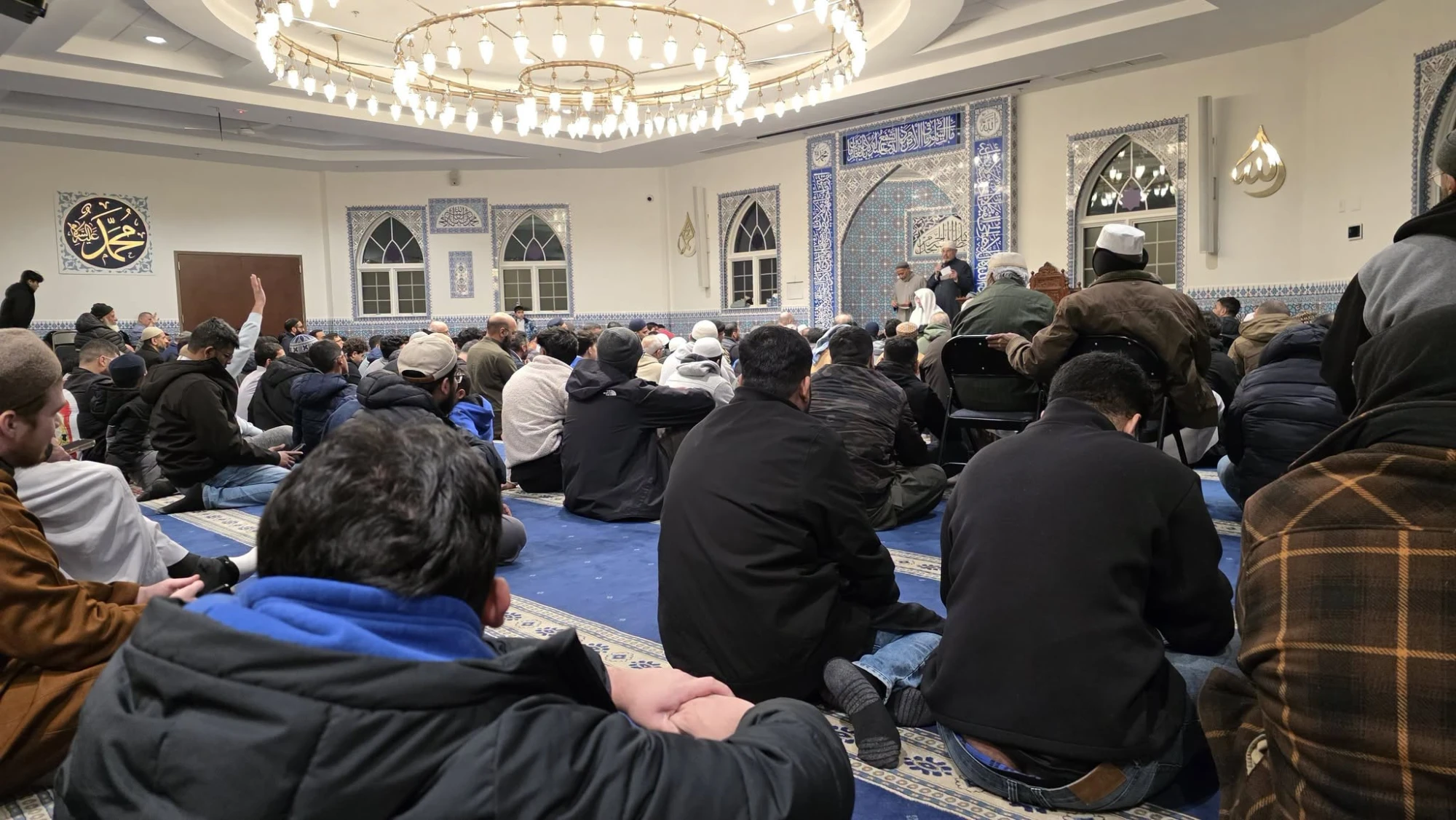
The Islamic Society of Central Jersey has been serving New Jersey for more than 53 years. From its campus in Monmouth Junction, ISCJ runs one of the state's largest and oldest Muslim communities — a masjid, a K–10 Weekend School, a Qur'an Academy, the Sanad Institute, and Learning Islam Together (LIT), a program for youth and young adults ages 13–30. Thousands of families touch at least one of these programs every year.
A community that size, operating for that long, accumulates something along with its history: systems. Registration systems, payment systems, spreadsheets, form tools, group chats — each adopted by a different committee at a different time to solve a different problem. By the time ISCJ approached DeanDesk, those systems had grown into something no single person could fully see.
A digital transformation on this scale normally takes six months to a year — often longer. With DeanDesk's institutional platform and migration tooling, ISCJ went live across every program in a matter of weeks. This is the story of how.
Four programs, four islands
When we mapped ISCJ's operational landscape at the start of the engagement, each program was running on tools that were never designed for the job:
- Qur'an Academy ran registrations through Cvent, an event-management tool, with communication scattered across multiple channels. Every enrollment and every payment was completed manually.
- Weekend School enrolled K–10 families through JotForm — with ISCJ membership dues quietly bundled into its fees.
- Sanad Institute collected payments through JotForms and coordinated through WhatsApp and other informal channels.
- LIT used JotForm for both payments and registrations.
None of these systems talked to each other. A family enrolled in three programs existed as three unrelated records — with three chances for a typo to split them into four.
The deeper problem wasn't the tools. As we worked alongside each committee, we uncovered layer after layer of business logic and tribal knowledge that had never been codified anywhere — how a particular discount was supposed to combine with another, which families paid dues through which program, why a certain fee existed at all. The systems worked because a handful of dedicated people carried the rules in their heads. That is exactly the kind of institutional knowledge that makes a migration slow: before you can automate a process, you first have to discover that it exists.
Hundreds of volunteer hours, one enrollment at a time
Qur'an Academy made the cost of the status quo concrete. Because its registration tool couldn't express the program's real pricing — custom payment options, member discounts, sibling arrangements, case-by-case adjustments — every single enrollment and payment was completed manually. Volunteers spent hundreds of hours each cycle applying discounts by hand, arranging custom payment schedules, and chasing down confirmations.
Today, Qur'an Academy's registration runs itself. DeanDesk's discount engine evaluates rule-based eligibility automatically at checkout: membership-status rules, sibling discounts computed from a family's active enrollments, multi-class bundles, and code-based promotions — with fine-grained control over which discounts stack and which apply to the first billing cycle versus every renewal. Rules can reference any field on a family's profile and combine conditions with AND/OR logic, which means the thousands of possible product-and-discount combinations that volunteers once resolved by hand are now resolved by the platform in milliseconds — consistently, and with an audit trail.
The hardest lift: 25 years of membership, kept by hand
The centerpiece of ISCJ's operation — and the hardest part of the transformation — was the masjid's centralized membership model.

ISCJ has more than 25 years of membership data, and all of it lived inside the accounting team's tools. Every membership payment and every ledger entry was recorded manually. Dues arrived through more than five different channels, and the accounting team had to reverse-engineer transaction data to keep the books straight. Weekend School was the sharpest example: membership dues were built into its fees, so accountants would comb through Weekend School's transactions line by line, log the membership portion into QuickBooks, and manually reconcile the remainder as Weekend School revenue.
Meanwhile, the programs that depended on membership status had no way to check it. Qur'an Academy offered large discounts to ISCJ members — verified by nothing more than an honor system, potentially costing ISCJ thousands of dollars a year in unearned discounts.
One identity, one membership, every program
DeanDesk's institutional architecture was built for exactly this shape of organization: one institution, many programs, one community.
Each ISCJ program got its own branded DeanDesk portal on its own domain — Weekend School, Qur'an Academy, Sanad, and LIT each keep their own identity, courses, and enrollment flows. But underneath, they share one thing: a single institution-level identity for every community member, with membership attached to the institution, not to any one program.
The result: when an ISCJ community member signs up for anything, on any of ISCJ's DeanDesk sites — a Weekend School enrollment, a Sanad course, an LIT event — they automatically receive a membership entitlement that every other ISCJ program recognizes instantly. The honor system is gone. Qur'an Academy's member discount now checks a real membership record at checkout. Weekend School's dues are their own line item, cleanly separated from program revenue the moment a payment is made — nothing left for accounting to untangle.
Migrating 25 years of data without a year of migration
Getting to that clean picture meant moving decades of disorganized, often incomplete financial data out of QuickBooks exports and Excel spreadsheets and into a structured membership database — including records for thousands of people, many of whom had never had a login to anything.
This is the part of a transformation that traditionally consumes months. ISCJ's took days, because the entire pipeline was automated:
Three pieces of DeanDesk tooling did the heavy lifting:
- The DeanDesk MCP server let us normalize thousands of rows of inconsistent source data with AI-assisted tooling — mapping columns, reconciling name variants, and repairing gaps — inside sandboxed migration workspaces where every batch is validated before it's promoted to production. Nothing raw ever touches live data.
- Bulk membership import with identity matching. Every historical row is matched against existing accounts through multiple fallbacks. When a match exists, the membership entitlement activates immediately.
- Pending membership entitlements. Here's the part we're proudest of: for the thousands of community members who had never had a login, DeanDesk created membership entitlements anyway. Each one waits in a pending queue carrying the person's full membership history. The moment that person signs up for anything in the ISCJ ecosystem — even years from now — the platform automatically matches their new identity to their historical record and links their membership, with no admin involvement.
That last mechanism is why the launch numbers look the way they do. Since going live, out of thousands of rows of migrated membership data, exactly one person's account has needed manual activation. Everything else has linked itself.
Weeks, not months
The rollout itself followed a disciplined, repeating rhythm. Each program moved through the same four phases — data migration and setup, staff onboarding, live training, and go-live — staggered so that each committee got dedicated, hands-on attention from the DeanDesk team while the overall timeline stayed compressed.
Because migration, onboarding, and training ran as overlapping waves rather than one long sequence — and because the data work was automated rather than re-keyed — the whole institution went live in the time a traditional implementation spends on discovery.
Where ISCJ stands today
- Registration is self-service. Qur'an Academy enrollments that once consumed hundreds of volunteer hours now complete online, with complex rule-based discounts, membership pricing, and thousands of product-and-discount combinations applied automatically.
- Membership is a database, not a filing cabinet. One centralized membership record powers all four programs, with 25+ years of history preserved and every entitlement verifiable at checkout.
- Accounting reconciles nothing by hand. Dues and program revenue are separated at the moment of payment, with real-time reporting per committee.
- The community gets one front door. Whichever ISCJ program a family joins first, their membership — and its benefits — follows them everywhere else.
One of New Jersey's oldest Muslim communities now runs on infrastructure as connected as the community itself. And the honor system? Retired, after 25 years of faithful service.